
The One Thing that Matters as a Manager
It’s motivation.
What makes a great employee in 2025, in this era of high uncertainty and hyperspeed change?
Someone who is highly adaptable. Who brings in ideas from different areas, sees new possibilities, and executes on them. They lean into change and evolution. They see ways to improve, to get new business, and they get other people excited to work on making this happen.
How do you find such people, keep them, and most importantly, make sure they don’t quiet quit? Your job as a manager is to find, retain, and enable such people. All of these traits require motivation. The quickest way to get a quiet quitter is to demotivate them. Suddenly, your excited, interested employee is a task rabbit waiting to be told what to do.
Motivated employees will do their best work, go the extra mile. If you’re a good manager, your reports feel motivated and come to work excited, feeling a drive to deliver.
How do you do this? The first step involves really getting to know your employees.
Find what motivates each person, and provide that
I follow a product manager on social media who often posts about how she affords living in New York City and still traveling while raising a child. When people ask her how she does it, she says a big part for her has been seeking out managers who will fight for her to get a higher salary. She specifically told each of her past managers that she is motivated by money: she would put in extra work if it meant she got rewarded monetarily. This works out well for the managers (she works hard for their goals), and for her (she can afford the lifestyle she wants).
Most employees and team members you have won’t tell you what they need so directly. You have to figure it out together with them.
One of the best tools I’ve used for finding what motivates teams is the Moving Motivators game by the folks at Management 3.0. It’s not really a game, more of a reflection exercise you can do together with your team.
It has cards with ten key motivators listed on each card:
Curiosity: I have plenty of things to investigate and to think about.
Acceptance: The people around me approve of what I do and who I am.
Power: There’s enough room for me to influence what happens around me.
Relatedness: I have good social contacts with the people in my work.
Goal: My purpose in life is reflected in the work that I do.
Honor: I feel proud that my personal values are reflected in how I work.
Mastery: My work challenges my competence but it is still within my abilities.
Freedom: I am independent of others with my work and my responsibilities.
Order: There are enough rules and policies for a stable environment.
Status: My position is good, and recognized by the people who work with me.
Each person organizes the cards in descending order, from what’s most important to them to what’s least important. It’s good to read out the top and bottom 3 motivators to the group, so that each person in the team can understand what motivates the others, and which things aren’t a motivator for them.
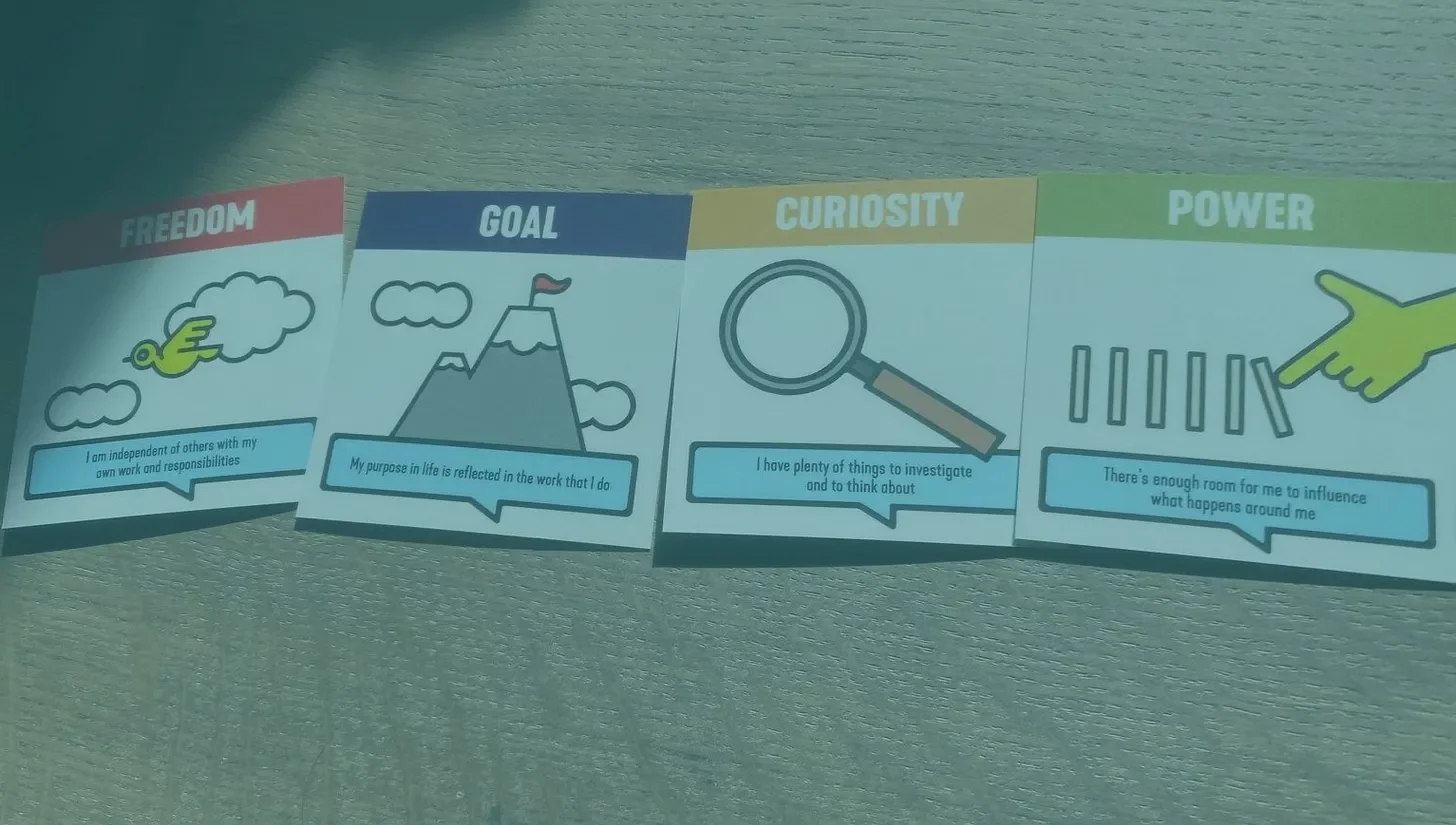
A sample of some cards from the “moving motivators” game
The Moving Motivators game can be used as a one-off, or to assess how changes will impact your motivators. You can use this when discussing potential career moves, or voicing what you’d like to see change in your role or your team.
If relatedness is a big goal for you, then moving into a new job in a cut-throat industry is unlikely to make you happy. If curiosity is a key motivator for you, then moving into a team lead position where your focus is on a single topic will likely feel boring and stale. Freedom and curiosity are two of my top motivators. This impacts the types of roles I go for. I know I will be happier and more motivated to do great work when I’m in a role where I can explore a lot of different topics and freely seek out projects and initiatives I’m interested in.
Focus on the big stuff
Once you know what motivates your team members, your job is to enable those motivators for them. That’s really it. As Andreas Klinger states, your job as a manger isn’t to manage people, but to manage processes and lead people. Manage processes so that they lead to motivated people who are free to do great work, and lead people by inspiring them and providing them with the framework and mindset to do great work. Recurring check-ins with team members should focus on their motivation, not as a check-in on what they’re doing day to day. These operational topics should be shared in project check-points or product sprint reviews. Your one-to-one meetings with your direct reports should focus on them, how they’re feeling and if they are getting the motivation needed to do their best work.
Thanks for reading! Subscribe for free to get Common Digital directly to your inbox
The most important thing you can do for motivation is give people ownership.
If you look at the ten motivators, none of them can happen without having autonomy. Even the ones that involve other people, like relatedness, require the person to be able to build their own relationships (ex. not connected to their boss). Andreas Klinger also correctly notes that burnout is caused by a loss of control and/or impact. You know how you can work on a passion project until deep into the night and not even notice the time passing, and actually feel more energized from it? That’s because you’re motivated by this passion project. These experiences show how burnout isn’t directly correlated with time spent working.
Think of the times you did feel burnt out. I imagine it wasn’t the times when you were working the most hours. For me, the times I felt most burnt out was when I was in teams working toward unclear goals, where managers didn’t let their teams experiment and try other ideas. They managed down to their teams, micro-managing and attempting to control their direct reports, rather than managing up and working with the other management to clarify goals or bringing in new business.

In preparing this article, I heard from an acquaintance (let’s call them Jeff) who said their last manager was obsessively focused on timesheets. Jeff’s manager, the head of a regional office at a small consulting firm, told his team that correct timesheets were “priority number 1” for the team. Obviously, administrative tasks should not be a first priority of any team. What caused Jeff’s manager to say this, and what impact did it have on the team and their motivation?
The manager used these timesheets to track employees, which made them stressed. There weren’t many projects coming in, and employees were afraid to put too much time down for non-billable activities. The manager would pull these timesheets up in every one-to-one meeting with the team members, asking them to explain long lunch breaks or days where they came in after 9 (although, unsurprisingly, he wasn’t concerned about days where they stayed longer).
I asked Jeff what effect this had on the team. Of course, he said the team’s morale was in the gutter. But he said the most annoying thing for the team was that they felt their manager was focused on the wrong things. The manager was clearly stressed by his P&L numbers being among the worst in the company. Instead of focusing on business development and bringing in more revenue—which would have solved the timesheet problem by giving the employees more billable work—he focused on the thing that seemed easier to control: the cost side. Despite the fact that saving a few hours of employees’ time won’t impact P&L nearly as much as a new project or new client bringing in new business.
Things like obsessively controlling timesheets are tempting for managers, because they’re easy to get a good feeling from. They provide clearly-communicatable metrics. But these are vanity metrics, metrics that have no real relation to business success. The amount of time a person has billed to a project, or the number of hours they were sitting at a desk, says nothing about the quality of their work or how far the company is moving toward its goals.
People have to feel they have self-control, the ability to dictate for themselves how their life unfolds. Your job as a manager is to create the conditions where people want to use their time and energy to further your goals, and the company’s goals. This means creating conditions where they can tie their own success, their own motivation, to your goals.
Think about it
Think back to your best manager. What did they do? What made them great?
What are your top 3 motivators?
