
Fixing Hiring in the AI Age
Interviews = Time Lost
Interviews take time. A lot of time. In the past couple of months, I’ve spent probably 20% of my working time either in interviews or reviewing candidates from recruiters. Writing that out, that seems absurdly high. But I don’t think it would surprise anyone working in high-growth industries.
Time is our most essential resource. What we do with it determines our success. We justify spending a lot of time on interviews and hiring because the people we add to our teams are important, what they do with their time in our companies is important. The right employees help your organization grow into its next phase (there’s always a next phase). The wrong ones hold you back, slow you down, and in the worst case, cause your good employees to leave.
In interviews, we try to identify which bucket the person falls into: the good or the bad, the growth-drivers or the growth-laggards.
Are our interviews designed to capture this?
We should think of interviews not as “a chance to get to know someone,” but as time lost. Every hour spent on interviews is time not spent on reaching your other goals, not, well, working.
This isn’t an explicitly negative framing of interviews. It should just serve as a sobering reminder of what interviews cost. If you only hire one out of ten people you interview, and each interview process takes on average 1.5 hours of your time (assuming some processes will end after 45 mins, other will take 2+ hours in total), you’ve spent over a quarter of a week’s working hours on hiring just one role. Surely, there must be a way to improve this: to limit this number while still hiring the best people.
Of course, it’s not only your time that interviews waste. Think of the people you’re interviewing. They likely had to take time off from their current job to interview. They had to spend additional time researching your company, preparing questions, and probably completing some take-home interview task. They likely have other interviews at other companies, too. You should only take the time from them that you absolutely need.
How can we limit the time wasted on both sides? How can we make hiring work better? How does AI come into play here?

Photo by Van Tay Media on Unsplash
First, let’s look at what isn’t working, and what’s gotten even worse in the age of generative AI. Then we’ll discuss how to make it better.
Why do we interview? To find the signal in the noise
We don’t conduct interviews just to “get to know” people. We want to find out if a person will help our company reach the next phase of its life. We want to know:
What skills they have that we don’t yet have in the team.
How the person thinks, how they identify new solutions.
How the person works, and if that’s a fit for how we work.
If our futures are compatible: if the person is at the right stage in their life to help lead our company to the next stage of its life.
When we interview people, we want to get as much signal as possible: that is, as much relevant information as possible that helps us decide if we should bring this person on board. We want information that we can’t get from the person’s CV, and we want to validate that the information in their CV is actually true.
Most interviews amplify the noise.
If noise is made up of irrelevant information that doesn’t help us arrive at the answer of whether or not a person will help us get our company to the next phase, then a lot of our current interviews are just generating noise.
Think about how much of interviews involves no new information. How many times basic introductions are repeated. How much time is spent reading back information from a CV. How much time is spent repeating the same questions. Our hiring processes take so much time because they aren’t focused on removing noise. They often add even more noise.
Noise can also mean overlooking or not focusing on information that may say the candidate can help the company get to the next stage because we’re focusing on information that’s applicable for one specific role. Imagine you’re the CEO of a high-growth biotech start up. You have 5 roles open across sales, operations, and R&D. You’re on a call with a candidate for a Research Scientist position in the R&D department. The candidate is a young, well-connected scientist from a top university who helped connect dozens of other scientists to alumni donors when they led an on-campus accelerator program during their master’s (they don’t have a PhD, a qualification you’d prefer for this role). They are extremely excited about what your business does. They came to the interview full of ideas about how to position your company, excitedly chatting about what competitors are up to and things they’ve seen at recent conferences. If you’re interviewing them solely for the researcher position, you would likely turn them down in favor of more experienced researchers with better credentials. Yet you might have a fantastic business developer on your hands: one who can speak to technical clients and really understands how your product can solve their challenges and why it’s state of the art. Often, we ignore the signal by limiting people to the role for which they applied, rather than investigating how their skills, interest and enthusiasm could bring our business forward.
Hiring in the AI Age: More Noise to Cut Through
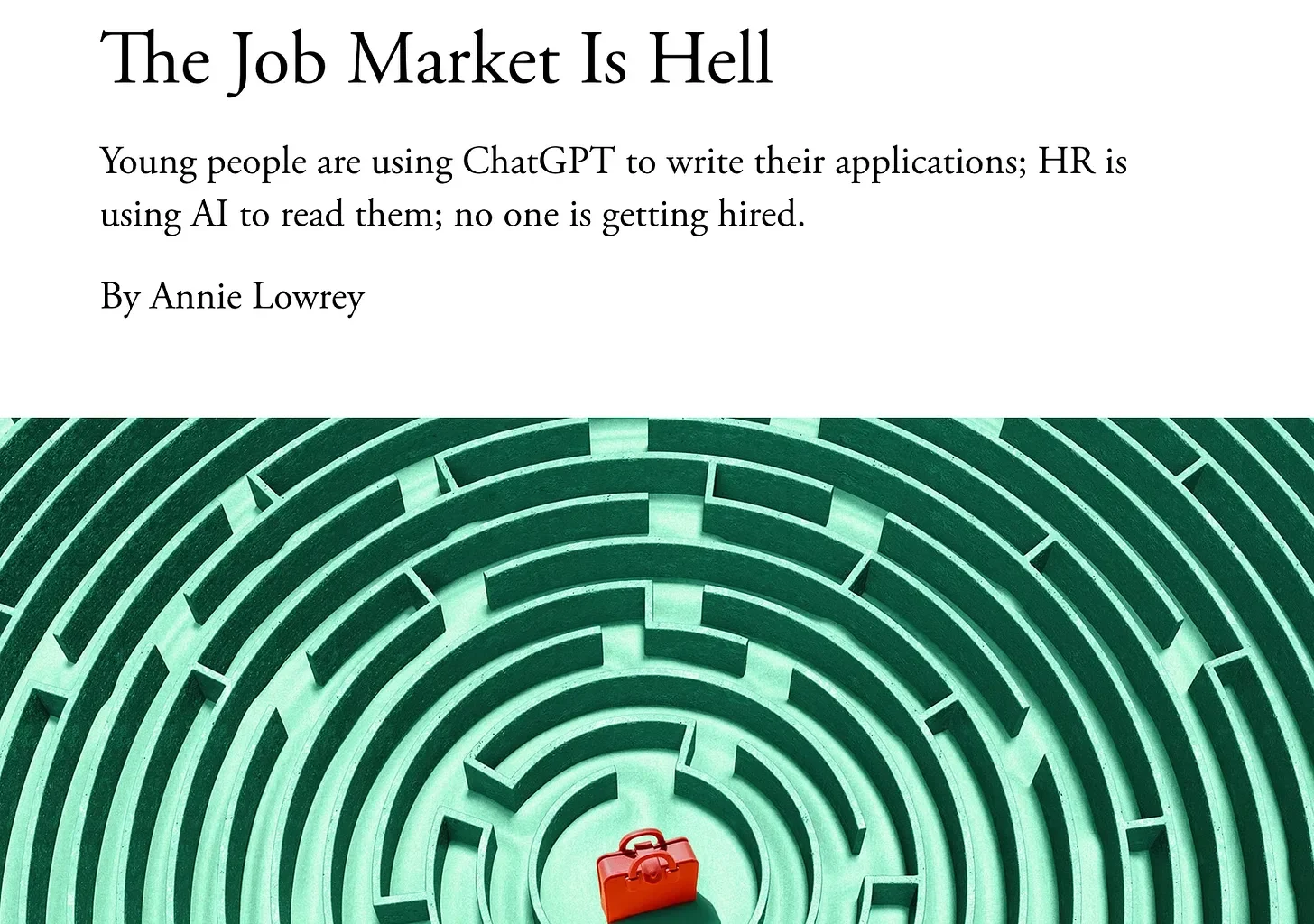
A recent viral headline from the Atlantic summed it up perfectly: Applicants are using AI to write their applications. Companies are using AI to screen them. No one’s getting hired. For employers, applications from bots add even more noise and make it harder to identify which applicants are even real, let alone good.
I also believe generative AI has hurt the hiring process more than it’s helped. Even for candidates who aren’t bots, it’s become harder to identify the truth in what they’re saying. I’ve had interviews where the candidates were clearly using a Cluely-style “AI cheating tool”. When I asked a question, they would repeat the question, their eyes would dart obviously to another screen, and they would nervously pretend to think about an answer for a few seconds. Theirs eyes would then would flicker left to right as they read an obviously AI-generated response that they clearly did not understand. One candidate even started reading such an answer by saying “It sounds like you’re asking about...”, an obvious indication that they are reading the start of an AI-generated response.
The other way GenAI has made the hiring process worse, in my experience, is in candidate preparation. Even in interviews with candidates for senior positions, candidates have struggled to answer the extremely basic question “why do you want to join?” When asked the even more basic follow-up question “what does our company do?” some had no idea. It appears that in the AI-age, where answers to anything can be instantly generated, people aren’t making it a priority to prepare ahead of time and are doing a lot more things without a lot preparation, expecting to wing it.
This is my personal experience. To get a more holistic picture of how genAI is shaping hiring, I spoke with someone whose sole focus is hiring: an experienced recruiter.
Recruiter’s View:
I spoke with Matt Brady, founder of sedulo search, a specialized recruiting firm focusing on talent in the fraud detection space, to hear his insights from both the candidate and company sides of the interview equation. He said generative AI has made the hiring process definitively worse. But, he said a distinction needs to be made between GenAI and automation. He mentioned automated notetaking, scheduling, and follow-ups as useful and time-saving. But generative AI is having the effect of adding more noise to the process. Job descriptions, many of which are now generated with AI, all sound the same. This makes it harder for candidates to tell what companies are really looking for and what the role would really involve. It also means hiring managers and HR departments are not spending as much time consciously thinking about what they want in a new team member. It may also add additional requirements that aren’t really necessary, like automatically generating a list of software packages commonly used together but that might not be necessary for the particular role, and discourage good candidates from applying. It’s also led to more predictable interview questions.
Many hiring managers I spoke to across various industries said that they’re seeing a much higher quantity of applications, but the average quality is lower. I assume this is caused by ChatGPT and other GenAI tools making it easy to generate a passable cover letter and CV, lowering the bar to apply for a job, which likely leads people to apply for jobs they aren’t really interested in and wouldn’t have invested any significant amount of time into if they’d had to do so.
Cut through the noise to the signal
With generative AI being used on both sides of hiring, it’s become more difficult to cut through the noise and find the signal. We need to overhaul our hiring processes to save time for candidates and hiring companies, focusing on getting to the signal as quickly as possible.
Humans themselves are the signal. Paper and fluff are the noise
We’ve long heard it said that “people hire people, not paper.” This has become even more true in the age of AI, where what’s on a piece of paper is less likely to have been written by a person. Matt said that he’s seen personal brand become more important in hiring. This makes sense: a curated personal brand is built up over time, it’s not something that can be easily faked or embellished. Matt also mentioned that hiring managers are looking at industry conferences for potential new colleagues. This fits the wider trend toward portfolio careers, where people link together their work across employers, volunteering, and side-projects, and make this work findable to future employers and collaborators on blogs and personal websites.
This shift back to in-person and relational capital is also happening in interviews. Rather than feeling like a relic of a bygone era, in-person interviews feel refreshing after so many years of fully remote hiring processes. Especially in-person interviews with an impromptu component can give a lot of signal about how a person works and what they really know without their digital pacifiers.
Strategy consulting has long had success with this type of interview. It lets them see how a candidate would react in a high-stakes moment with a client. In impromptu presentation interviews, the candidate has to make a recommendation in a short time, present it, and field challenging questions about their recommendations. At the start, they receive a brief of a strategic question, like about how to grow one part of the business. The brief contains basic facts about the business unit, its current positioning, and overall market trends. They then have 20 minutes alone with only the brief and a flip-chart to prepare a 10 minute presentation with their recommendations for growing the business unit, followed by questions and discussions from the interviewers.
The format could be further improved by giving the candidate only a clock and taking their phone for the 20 minute preparation time, or checking in advance what answers common chatbots would give and pressing the candidate if their presentation seems to mirror what a chatbot would say. Even if candidates are expected to use enterprise AI tools in their jobs, this isn’t what interviews are meant to test. The candidate should be able to form their own opinions and complete a core task of the job without AI.
Matt confirmed that he’s seeing in-person interviews making a comeback with his clients. Particularly for more senior hires, it’s important for companies to see how the hires work under this time pressure, how they respond to criticism and defend their work. Speaking from experience, I can also say it’s a much better experience for candidates. People on both sides of the interview table aren’t multi-tasking and half-listening. They’re completely engaged and focused.
What better way to cut through the noise than with an intense, targeted task and presentation squeezed into a short time-block?
Summary: How to get to the signal
Integrating an intense in-person interview really helps cut through the noise. But there are other things we can do to improve our hiring processes and find the best candidates currently hidden under piles of AI-generated slop applications and hours of interviews with copy-paste questions.
Before the interview/application:
Automate deal-breakers, make these explicit. Put salary ranges on your job ads. Lots of time is wasted on both sides in interviews where the candidate has a salary expectation the employer can’t meet. Avoid this by putting salary ranges and any other deal-breakers, like having the flexibility to travel frequently or speaking a certain language fluently, in the job posting. You can add these as mandatory fields in the application form. Use them to trim your candidate pool candidates you can seriously consider.
Poach people. Get the best people in your interview pools by poaching them! Don’t wait for people to apply, hoping they’ll stumble upon your website. If you see someone great at a conference or meetup, approach them and tell them you’re looking for people like them. Think of this as saving hours of time and thousands of dollars, because it is.
Host community events, hackathons. This is a great way to showcase your company to potential employees. If someone shows up to such an event, you already know they’re highly motivated and going above and beyond. If they weren’t, they wouldn’t join such an event on their own time and dime. These events let you see how people work on the specific problems your company has.
BUT: have to have a clear path to hiring from these events. A lot of companies don’t have a clear path for following up with the best performers after the event ends. Send an email immediately after the event with a link to your careers page. Add a special button for event attendees to check saying they were at the event, and screen these applicants first. You could even schedule initial interviews with some of the best performers directly at the event.
Do more homework. Spend some time every month actively looking at your human resources holistically. Start with your goals. Where do you want to get to? Where do you have capability gaps or resource constraints in getting there? Then look internally. Who do you have internally who wants to grow in this direction? Then, look at what the core character traits are that are needed, not skills. Do you need well-connected coalition builders for this next stage? Technical wizards? Decisive action-takers? Then you can:
look at your network (first),
your initiative applications (second),
and make a job posting (third) to fill this gap.
In that order.
First interview:
Automate the basics to save time. Before you schedule the first interview, ask for applicants to send a short video where they introduce themselves and answer a few basic questions (highlights from their past experience, a project they’re proud of, etc.) This can be shared with the panel of future interview rounds to save time on both sides, and can be used to weed out people who are obviously not a fit, or clearly not interested (if they don’t take the time to make a 2-minute video, they are clearly not interested). Imagine how much time we could save if we stuck to the rule that people should only give a piece of information once. If they agreed to the salary range in their application, they shouldn’t be asked this again and again. If they recorded their introduction in a video, let that formality fall away in the interview.
Use the interview to really see what they know. Invite them on site for one single, short, focused in-person task. Be fully present and ready to ask anything you need to know to make a decision after that interview.
Use references and work examples:
Ask for their portfolio. See what other information and materials they can provide to help your decision. Do they have open-source contributions on their GitHub? Links to past conference presentations?
Personal references. References are often contacted only at the end of the hiring process, if at all. We could save a lot of time contacting them earlier in the process.
Be flexible for candidates with strong references and portfolios. Reward this work with fewer interview rounds. Let yourself diverge from the script. Tailor your questions (and process) for candidates who have proved their knowledge in other ways.
If the real goal is finding people who will bring your company to the next stage, you’ll see that there’s a lot of fluff in this process that can be cut away. Focus on finding the signal through the noise, then listen to what that signal is telling you. A “meh” is a signal: it’s a no.
Think about it:
What was your best interview experience as a candidate? What did you like about it?
What other ideas do you have for cutting through the noise and making the hiring process more efficient?
