
Do you have ownership? Or just "responsibility"?
Have you even been in a team where it’s not clear who’s doing what? Where the goal of “self-organizing” devolves into a free-for-all? In my experience, such teams don’t last long: the good people get sick of the chaos and lack of tangible output and leave. The lack of deliverables eventually gets noticed, and someone comes in to try to clean up the mess.
People like knowing who to blame, or who to praise. These are the pessimistic and optimistic rationales for defining roles in a team. The practical view might simply say that we like to know who does what, that having clear roles helps simplify complex projects and bring clarity and purpose. All of these are understandable goals, and all likely contributed to the development of one of the most popular frameworks for assigning roles to members of a team: the RACI matrix.
RACI stands for “Responsible, Accountable, Consulted, Informed.”
I have always been confused by the RACI matrix and found it difficult to implement. The split between “responsible” and “accountable” was never clear to me. I now believe this is because the split is artificial and shouldn’t be there in the first place. Who should be “consulted” or “informed” says nothing about how to integrate those stakeholders’ opinions when making decisions. It’s time to build a new framework that empowers team members to deliver meaningful outcomes and make decisions.
I’ll explain why this split disempowers teams and creates unnecessary divisions. But first, an introduction to what each of the RACI roles are supposed to do.
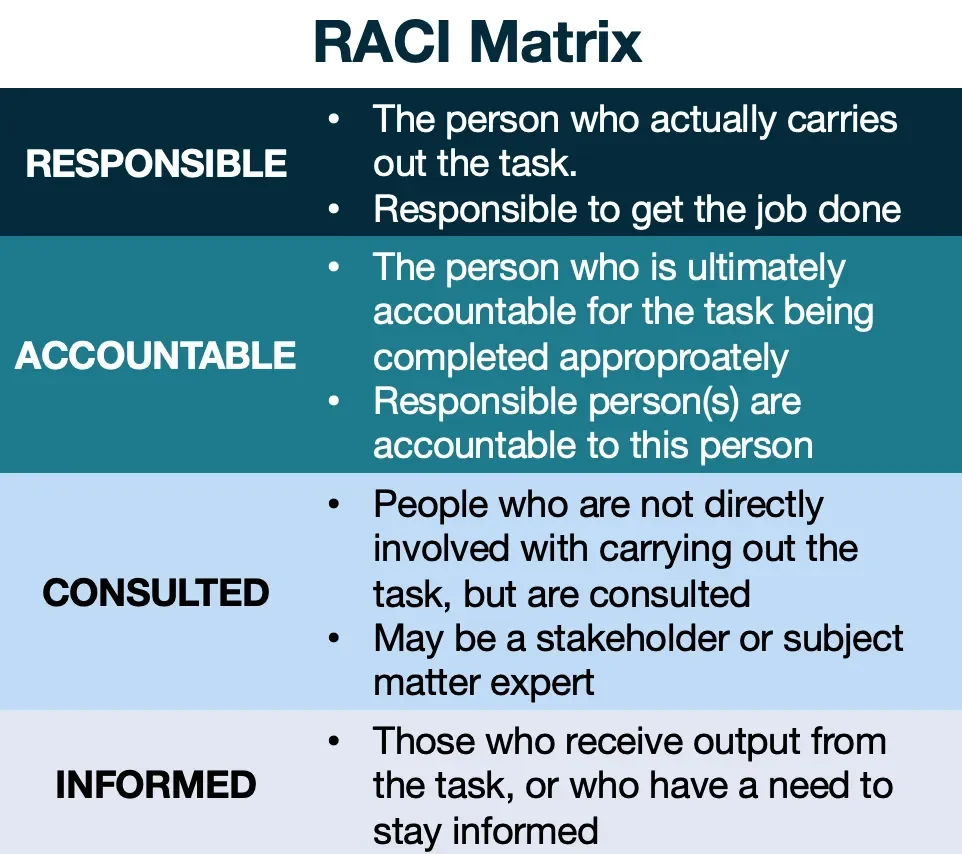
The standard RACI thinking goes that for a given team trying to deliver some outcome, there can be multiple people responsible for various tasks, but there should only be one accountable. There can also be multiple people who want to be consulted or kept informed. Typically, the accountable person ends up being a boss in some capacity: the team lead, department head, or product lead who will catch fire falling from somewhere above if the task is not completed (or not completed satisfactorily), or the desired outcome is not delivered. However, as shown in the definition above, they are not the one actually doing the work.
Huh?
This is where I always stumbled over RACI definitions. I couldn’t understand why “responsible” and “accountable” were often two different people. Shouldn’t the person doing the work, the one defined as “responsible” in the RACI definition, be the one accountable for it being done properly? If so, they have ownership of the task. Owning a task or deliverable means carrying it out to successful completion. By splitting accountability for the outcome from the responsibility for actually completing the task, the RACI matrix creates an unnecessary hierarchical layer and denies the person completing the task full ownership. If the accountable person is the one who will get flack for the task not being satisfactorily completed, they will naturally drive the person responsible for completing the task to complete it according to their specifications, which leads to micromanagement. The responsible person won’t feel real ownership of the task, since they are no longer free to complete it: their ability to call the task complete now depends on pleasing the accountable person and meeting the accountable’s definition of success. This means their goal is no longer to complete the task, but to please the accountable person. In practice, this creates an inefficient command and control culture flowing from the accountable person, who can only succeed vis-à-vis the responsible person’s work.
McKinsey identified additional problems with RACI, noting that it can lead to decision paralysis due to the unclear split between responsible and accountable members. It’s not clear what decisions the responsible person can make, and what the accountable person needs to decide. Since the accountable person is not working in the team, they often feel they don’t have enough information to make decisions. RACI can also lead to ineffective use of stakeholders, since those with a stake in the project are only “consulted” or “kept informed”, which are both very passive roles for these stakeholders.
What other options are there?
Other acronyms like DACI (Driver, Approver, Contributor, Informed), and DARE (Deciders, Advisers, Recommenders, Executers, from McKinsey) have popped up as successors to RACI that attempt to fix some of RACIs flaws.
I believe most of the problems with RACI can be solved not with more confusing acronyms, but by following a few simple rules:
1. Clearly-defined goals that owners co-define. In my experience, RACI role definition is primarily used to attempt to make sense of fuzzy tasks in which many stakeholders have a vested interest. It’s best to focus on fixing this core problem of poorly defined goals and tasks, rather than getting pedantic about role names and adding an additional “accountable” reviewer/approver. Tying tasks to wider goals also helps people feel motivation to complete the tasks.
2. Restore full task owners. It’s simple: combining the responsible and accountable roles into one empowered delivery owner who has full freedom to decide how the task should be carried out. This person can also decide which other stakeholders to inform or consult, how, and when. Of course, this person has more decision-making power than any of the roles previously separated in the RACI model. That’s the point.
3. Make owners doers. Unlike the accountable person in the RACI model, a full task owner must be fully able to manage bringing the task to completion. This doesn’t mean they do everything themselves. Rather, they are able to complete the task as they see fit by tapping into the knowledge and skills of the rest of the team, and are free to delegate decisions to other members of the team. This eliminates micromanagement by an accountable person who is not getting their hands dirty and not involved in the day to day work with the team.
4. Give owners full ownership over necessary resources. Owners should decide which resources they need, including team members, external support, and tools. They need to have ownership (i.e., decision power) of their own budget.
Konrad Urban (@konrants), founder and CEO of the payments startup Peanut, agrees that ownership is key to motivation. He told me how he saw a big increase in motivation (and productivity) at Peanut when they started actively trying to maximize ownership across the team. They encouraged people to take ownership of projects or product features they felt excited about, regardless of how well it fit into the role they were hired for. They trust their team members to learn and grow, and of course to tap other members of the team for help along the way.
Empowering task owners can feel scary, especially for people who were formerly accountable for tasks and are more accustomed to approving tasks than completing them. But isn’t it better to be accountable for things you can do, than being accountable for things you’re reliant on others to do for you? For companies, giving one person full, unambiguous ownership of achievable, clearly-defined tasks eliminates extra layers of inefficient managerial friction and speeds up decision loops—all without having to memorize any acronyms. Call it empowered ownership.
How would this work in practice?
Moving from RACI approval loops to empowered ownership
Imagine an e-commerce company that’s preparing for the busy holiday season. The company wants to use the holiday period as an opportunity to increase its market share and increase loyalty among customers of its brand.
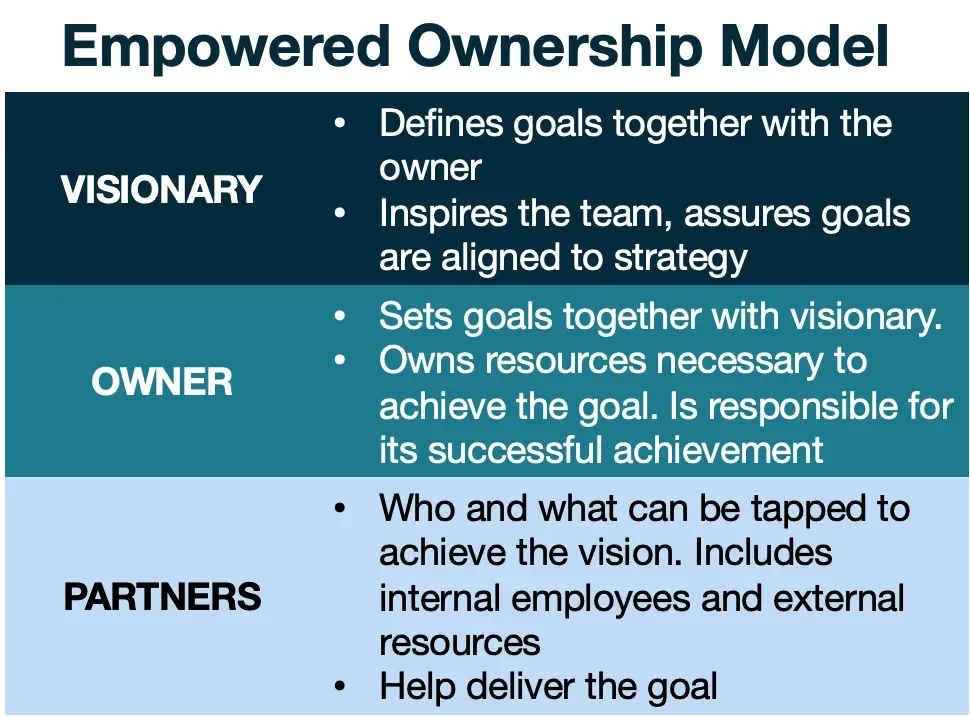
How would the successful accomplishment of this campaign look in the empowered ownership model? There would be three types of roles:
Visionary: Leader one who inspires the team. They work with the owner to define goals.
Owner: Sets goals together with visionary. Owns resources necessary to achieve the goal. Is fully responsible for its successful achievement.
Partners: Who and what can be tapped to achieve the vision. This includes the other people in the team, people in other areas of the company, external resources, and software licenses and other tools needed to achieve the goal. Partners help deliver the goal, and can also help with experimentation around potential solutions.
The visionary and the owner together agree on the goal to be accomplished. The visionary’s role is to assure the goal aligns with wider company goals and that it is ambitious, yet achievable. The owner knows what they are able to accomplish, together with their partners. This is very important: the owner must be able to decide how they will use their resources. Without that, they will not be able to give a good estimate of what goals are in reach, nor be able to fully own the task and accomplish it. Unlike team members who are commanded to work on a feature or sub-task, partners see themselves as crucial to achieving the goal. Naturally, their inclusion in future teams hinges on how effectively they work and how they help to achieve this current goal.
Let’s say for the holidays, the visionary and the owner decided on the following goal: gain 2% market share during the holiday season. They both agree this is feasible, given that the company had a 1.2% growth in market share last year during the holiday season, and competitor companies are showing some weakness, with one of the top competitors having quality issues.
Note that this goal does not include the how or detail the specific steps needed to reach this goal. The owner decides that, since the holidays are 4 months away, a feasible strategy given the resources would be to create a new marketing campaign focusing on best-selling products. If the timeline were longer, they could have also looked at other options, like new product creation to launch in time for the holidays. This goal informs what specific partners the owner will need to tap for the realization of the goal. For this example, the owner decides together with the visionary that they would need two members of the marketing team, one marketing analyst, a software engineer, and a $2 million budget to spend on whatever marketing channels the team thinks are best. Note that how these resources are used is at the full discretion of the owner. There is no earmark on the budget for specific types of marketing, like search engine ads. The owner, tapping the knowledge of their internal and external partners, is free to decide what they think is best. When teams have freedom to use their resources as they see fit, inefficiencies are often discovered. Uber showed one great example of this recently: they cut all of their Meta advertisement spend for driver acquisition when their initial data showed that it likely wasn’t effective in urban areas. Cutting this spend showed no significant change in new driver acquisitions, saving the company millions. This only happened because the team was free to choose how they spend their resources and change their approach.
The goal that is decided on together by the visionary and owner is constrained by a time box, the wider company goals and strategy relayed by the visionary, and the resources available to the owner. The two then decide together what is possible given these resources.
This ownership of resources is crucial. In many organizations, I’ve seen the following pattern repeated: someone is told they are “responsible” for completing a task that was handed down to them from management, but they do not own the resources necessary for completing the task. They do not have their own team, are not allowed to decide who else to partner with, and do not have ownership of the budget needed to move the task forward and are beholden to other managers for this (who have their own, often competing, goals and objectives).
How is the visionary involved during the time-boxed project time?
In short: they aren’t. At least not from an active management perspective. The owner doesn’t ask them for approval for decisions like spending the advertising budget, as the owner has full ability to decide that on their own. Of course, the owner can tap the visionary as a stakeholder or consultant, but they don’t have to. It’s up to them.
What happens if the goal is not achieved?
Since goals should be ambitious, it can of course happen that goals are not achieved. This is why post-mortems are an important part of the empowered ownership model. After the time box has passed, a post-mortem should be conducted with the owner, visionary, and partners. This is a great time to identify potential blind spots: was more data needed on the external environment? Was more experimentation needed to explore other potential solutions for meeting the goal? Did the owner have the right resources available to them? Did the owner have the skills and experience to own the delivery of this goal?
The owner, together with the team of partners they’ve assembled, are free to decide how to best orgnaize themselves during the time box. Having a single time box for reaching the overall project goal doesn’t mean that they can’t be agile within this time box. For example, the owner might decide to test out a few different marketing strategies and the beginning of the time box to see which one will work well for spending the remaining marketing budget at the end. That’s their prerogative: they know exactly how much budget they have to spend, they know the goal. Most importantly, they have full decision power to decide to try these agile manoeuvers.
For a post-mortem to be effective, a strong culture of 360º feedback is crucial. Everyone in the team should be used to giving each other open and honest feedback, and there should be a strong culture of self-reflection.
Things to consider when moving to the empowered ownership model
This model involves spending a lot more time on goal definition. Teams exist only for the duration of the time box and work toward a specific goal, so the goal needs to be the right one. It will be necessary to do some experimenting and analysis around the goal definition, especially at the start. Returning to the holiday campaign example: the visionary and owner were only able to agree on the goal because they had good data about their own company, their competitors, and market trends. This is a requirement of the empowered ownership model.
Initiatives over tasks or fixed teams
Throughout this article, I’ve often spoken of owners owning “tasks”. This was mostly out of convenience. It would be better to speak of owners owning initiatives. In an ideal world, the empowered ownership model would be combined with an operating model built around initiatives, rather than fixed products or teams. Imagine no longer having teams like HR and finance that complete certain tasks, but rather resource pools comprising internal employees, who are seen as partners with specific skills, and external partners. These pools are tapped to create dream teams built up around time boxed initiatives tied to strategic goals.
A more radical example would do away with fixed product teams that own products over their entire life span, and rather have teams built up for specific product-related goals. Meeting these goals might involve improving an existing product, or even winding it down. Though this would be a good use of resources and assure that no teams exist for longer than needed, most companies aren’t set up for this. Most companies still have separate departments that don’t see themselves as potential partners for achieving strategic goals, but as autonomous units working towards their own siloed ambitions. Shifting to an initiatives-focus helps companies see themselves for what they really are today: providers of discrete units of value, of which the vehicle of delivery can change.
After each initative, the company can take stock and update based on new information. Nothing is stagnant.
People considerations
I’ve heard managers say some people cannot handle responsibility, that they simply freeze when they have to make a decision. In reality, this isn’t an innate trait. It is often the result of command-and-control cultures that tells people they will be punished for making decisions or “not respecting the hierarchy”. This takes time to undo. In moving to empowered ownership, plan how you will support these employees through the change and help them take on more ownership.
You might have people who are both visionaries and owners: think of those founders who are also great scale-up CEOs. This is a great person to have on your team. However, their excitement might mean they advance their own pet-project idea. If someone is both a visionary and wants to own the execution of their visionary idea, by all means, let them. But with a caveat: have another visionary with a different point of view challenge their goal setting. Think of this as a board member challenging a startup CEO. A good visionary-owner will be happy for this tweak to the empowered ownership model that helps ground them and keep them on track.
Another pro of the empowered ownership model is that everyone in the team knows not just what they’re doing, but why. They are working towards a specific goal. The visionary’s main role is to help in defining this goal to be motivating and tied to a key company challenge. This helps everyone feel more ownership, not just the owner. In the RACI model, those who are “consulted” are often frustrated that their opinions aren’t integrated, and the “informed” stakeholders are completely powerless to shape the outcome. In the empowered ownership model, everyone involved is actively working towards the goal in some capacity.
Towards empowered ownership
Shifting to empowered ownership involves dismantling hierarchies and command-and-control management in favor of flexible teams working toward well-defined goals. It’s a model that fits modern digital work cultures, where tenures are short and employees want to learn and grow, who quickly tire of doing the same thing over and over. Though senior managers lose direct control over things like budget allocation and abandon their veto power over team decisions, they gain time and space for strategic work and empowered teams ready to go above and beyond.
Think about it…
What other advantages does empowered ownership have?
What could be potential pitfalls of the empowered ownership model?
Think of a time you felt empowered and like you had real ownership. What was the team set up? What framework were you working in? Do you see overlaps with the empowered ownership model? Are there other attributes that you experienced that are missing in the empowered ownership model?
